
Microlight » Meteorology » Atmospheric Stability
Atmospheric Stability
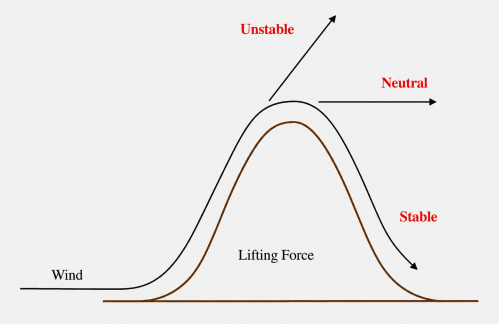
Atmospheric stability describes the tendency of a parcel of air to continue moving vertically or return towards its original level after being disturbed.
Stable Air
A parcel of stable air, when disturbed vertically, tends to return towards its original level.
Stable air is commonly associated with:
- stratiform or flat cloud;
- smooth flying conditions;
- poor vertical mixing; and
- haze or smoke trapped near the surface.
Remember:
Stable = Stratus and Smooth
Unstable Air
A parcel of unstable air, when displaced vertically, tends to continue moving farther away from its original level.
Unstable air is commonly associated with:
- cumuliform or lumpy cloud;
- strong vertical air movement;
- turbulence; and
- showers or thunderstorms if sufficient moisture is present.
Remember:
Unstable = Cumulus and Bumpy
Conditionally Unstable Air
Conditionally unstable air behaves differently depending on whether it is dry or saturated.
It may be:
- stable while unsaturated; but
- become unstable after saturation and cloud formation.
This occurs because saturated air cools more slowly as it rises than dry air.
Temperature and Stability
The stability of a rising or sinking parcel of air depends on its temperature compared with the surrounding air.