
PPL » Aircraft Tech Knowledge (H) » Forces Acting on a Helicopter Rotor
14.82 Forces Acting on a Helicopter Rotor
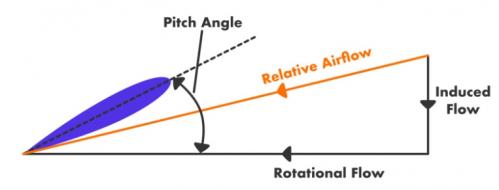
14.82.2 For a nil-wind hovering condition identify the following vectors:
(a) rotational flow;
- The airflow caused by the rotation of the rotor blades
- Acts parallel to the plane of rotation (tip path plane)
- Direction is opposite to the blade’s motion relative to the air
Summary:
Rotational flow is the horizontal airflow across the blade due to rotation, lying in the plane of rotation.
(b) induced flow;
- The airflow downward through the rotor disc produced by rotor lift in hover
- Acts perpendicular to the tip path plane (downwards)
Summary:
Induced flow is the downward airflow through the rotor disc generated by lift in hovering flight.
(c) relative airflow.
- The resultant airflow acting on the rotor blade
- Formed by the combination of:
- Rotational flow (horizontal)
- Induced flow (downward)
- Acts at an angle to the plane of rotation
Summary:
Relative airflow is the combined effect of rotational and induced flow, determining the blade’s aerodynamic behaviour.
14.82.4 For a nil-wind hovering condition identify:
(a) pitch angle;
- The angle between the blade chord line and the plane of rotation (tip path plane)
To see more, you must subscribe for licence "PPL" or sesssion "Aircraft Tech Knowledge (H)"