
PPL » Human Factors » Hearing and Balance
10.20 Hearing and Balance
10.20.2 Describe the basic anatomy (structure) of the ear.
The ear is composed of three main parts:
- the outer ear;
- the middle ear; and
- the inner ear.
Outer ear
The outer ear consists of:
- the pinna; and
- the ear canal.
The ear canal extends from the pinna to the eardrum
Middle ear
The middle ear is separated from the outer ear by the eardrum.
It contains three small bones called the ossicles:
- malleus;
- incus; and
- stapes.
The middle ear is also connected to the throat by the Eustachian tube.
Inner ear
The inner ear contains:
- the cochlea; and
- the vestibular system.
The vestibular system includes:
- the semicircular canals; and
- the vestibular sacs.
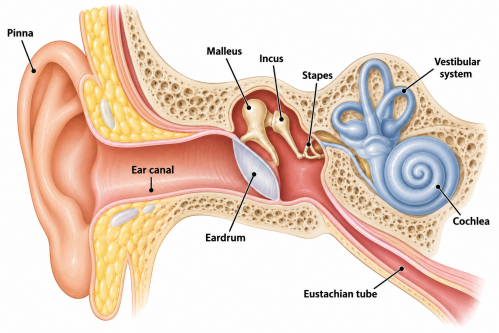
Key point
Outer ear — pinna and ear canal
Middle ear — eardrum, ossicles and Eustachian tube
Inner ear — cochlea and vestibular system
10.20.4 Describe the physiology (function) of the ear.
The ear detects sound waves, converts them into electrical signals, and sends these signals to the brain for interpretation.
It also plays an important role in balance and spatial orientation.
Outer ear
The outer ear collects sound waves and channels them down the ear canal towards the eardrum.