
PPL » Meteorology » Inversions
8.20 Inversions
8.20.2 Explain the factors involved in the development of a:
(a) radiation inversion;
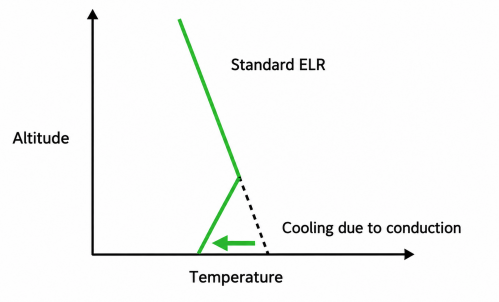
A radiation inversion is a surface-based inversion caused by the ground cooling at night.
At night, the earth loses heat by terrestrial radiation. The ground cools, and then cools the air in contact with it. This makes the air near the surface colder than the air above, creating an inversion.
Favourable conditions
Radiation inversions are most likely to form on:
- clear nights, because heat can escape more easily
- calm or light-wind nights, because there is little mixing
- long winter nights, because there is more time for cooling
- dry nights, because outgoing radiation escapes more readily
They are normally at their strongest around dawn, just before surface heating begins.
If the air contains sufficient moisture and is cooled to its dew point, then fog, dew or frost may form.
(b) turbulence inversion;
A turbulence inversion forms when mechanical turbulence mixes air in the lower atmosphere.
It often develops when there is:
- a shallow temperature lapse rate near the surface
- a surface layer of cool air
- enough wind to cause mixing, but not enough to completely destroy the inversion
To see more, you must subscribe for licence "PPL" or sesssion "Meteorology"