
BGT » BGT Aeroplane » Basic Turbine Engine Theory
64.2 Basic Turbine Engine Theory
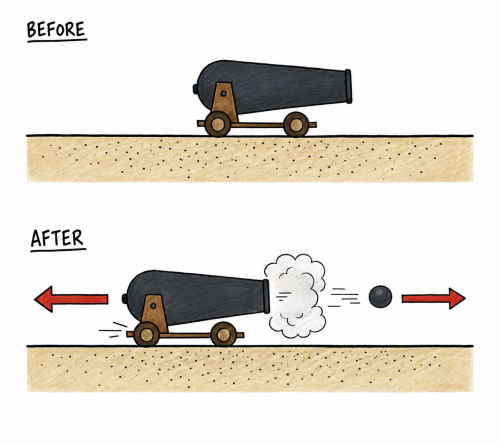
64.2.2 Describe Newton's third law of motion and its practical application as it relates to the operation of a turbine engine.
Newton's third law:
When one object exerts a force on another, the second object exerts an equal force in the opposite direction on the first.
"For every action there is an equal and opposite reaction."
64.2.4 Describe how gas undergoes changes in pressure, volume and temperature in accordance with Boyle's and Charles' Laws.
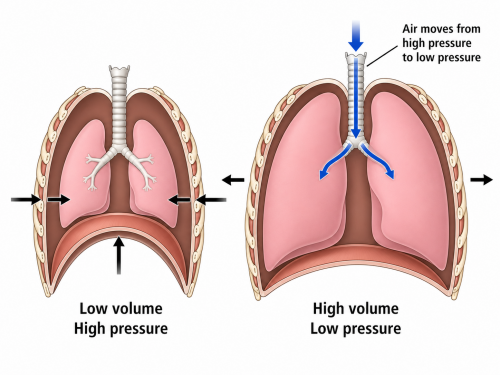
Boyle's Law
Formulated by the physicist Robert Boyle in 1662, states that the pressure (p) of a given quantity of gas varies inversely with its volume (v) at constant temperature.
Example:
In the lungs -
Inhale - Volume increases = Pressure reduces
Exhale - Volume decreases = Pressure increases
(Boyle's Breath)
Charles' Law
First suggested by the French physicist J.A.C. Charles about 1787, states that the volume occupied by a fixed amount of gas is directly proportional to its absolute temperature, if the pressure remains constant.
Example:
If we fill a balloon with air and seal it, the balloon contains a specific amount of air at atmospheric pressure, let’s say 1 atm.