BGT » BGT (A) » Turbine Engine Compressors
64.8 Turbine Engine Compressors
64.8.2 Describe the purpose of a compressor in a turbine engine.
The compressor in a gas turbine engine serves to provide the precise amount of air needed for fuel combustion, delivering it at the correct pressure and velocity.
It transforms mechanical energy from the turbine into kinetic energy within the air.
This process accelerates the air, which then passes through a diffuser.
The diffuser slows the air, converting most of its kinetic energy (velocity) into potential energy (pressure) and some into heat.
64.8.4 Describe the basic principles of operation of centrifugal and axial flow compressors.
A centrifugal compressor works by accelerating the incoming air radially outward, which increases the air's velocity and then converts the velocity into pressure.
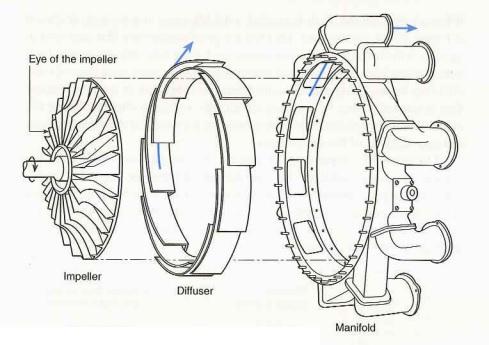
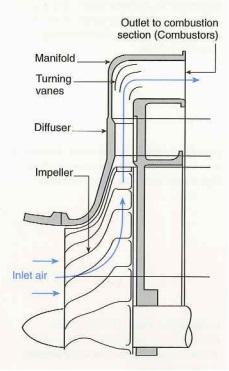
A typical single-entry centrifugal compressor
An axial flow compressor works by accelerating the incoming air parallel to the axis of rotation, which increases the air's velocity and then converts the velocity into pressure.
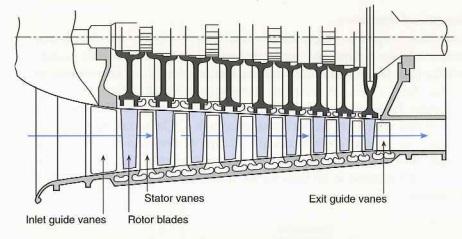
A typical axial-flow compressor
64.8.6 Describe the comparative advantages of centrifugal and axial flow compressors.
Centrifugal compressors were favoured in early gas turbine engines due to their: